Saturday, February 6, 2016

The Human Figure and The Politics of Nudity

Who knew that drawing the human figure would be so interesting? The politics (for lack of a better word) of being in the same room as a nude model are fascinating, the exploration of drawing materials is curious and frustrating and demanding and surprisingly exciting all the same time, and the outcomes are rewarding, even on a bad drawing day.


What do I mean by "the politics" of being in the same room as a nude model?

For me, having a nude model to observe is an opportunity like no other. When are we ever granted license to stare without shame upon the likes of another human in his/her most vulnerable physical state? In this scenario, I get to appreciate the body for what it is--its forms, shadows, and weight, how muscles move around bones, how light bounces off skin, the body's ability, its strength, its imperfections, and its beauty. I first started to appreciate this when my mom took us to the ballet when we were young. But this is a whole different level. Up close and personal.


Even if the model appears to be other than what our culture would consider the most beautiful, it is unpredictably empowering to see someone stand before us in what one might consider a compromising stance. Their seeming fearlessness and nonchalance gives me courage to be in the room with them and a confidence which allows me to think of my own body differently. Why should I feel modest or embarrassed? Whether I like it or not, no matter how much I consciously don't want it and seek to diminish it, no matter how feminist I declare myself to be, I have to admit that from time to time, self-consiousness about my non-Heidi-Klum body prevails. But standing five feet from a disrobed person and being granted permission to gawk at them for hours helps me allot value to my own frame, more than I've ever allowed. What about the way my muscles move around my bones? What is the contour of my face? How would I represent just the tiniest curve of my elbow or the shadow on my back? How does my own breast fall differently on my chest than the model's? What shape does my hair have?


Fun fact: models are paid an hourly wage, and so they should be--it's hard work! Have you ever tried to strike a pose and then not move? Try it for just a minute. Then try it for 5 or even 20. And if you need entertaining while you stand there, completely still, watch this fantastic animated video (4 min) about someone who takes the job very seriously. (I have watched it five times and lo-ove it.)
  

When I first painted the nude figure in a painting class a few years ago, I found myself astonished at the experience itself of trying to represent the nude figure at all. My nervousness at the outset abated immediately when we were given just one minute to try to capture his pose. What? One minute??? It took a few 1-minute poses to get in the groove, but once I did, well... would you look at that? Strangely, I noticed that in my mind, the model had gone from a person to an object in a split second. Wow. Is that even ok? In art-making, I believe it is, as long as we don't treat the model as such!

To be fair, I did have to giggle about the whole thing with my 30-something friends for a few days after that initial experience. You know, to process.


Relatedly, an added component of being in a classroom full of mostly younger people (18-20 year-olds) in this circumstance is paying attention to their behaviors. Foreign to me in this context, perhaps because I'm not in pursuit of a life partner, is the idea of sex. Before that split-second shift from human-to-object, are some classmates actually checking the model out?? The thought makes me chuckle under my breath and shake my head. Also, I have what I consider the advantage of more life experience, and indeed, I have seen more naked bodies just for having lived nearly twice as long as they have. With that comes maturity and, contrary to what I said about Heidi Klum before, slow (and deliberate!) acceptance of one's own body. I can't speak to what is going through the minds of my fellow drawers, but I can tell that some of them are uncomfortable. 

I once knew a student who desperately wanted to change her major to art, but couldn't handle even the thought of being in the same room as naked person. As Figure Drawing is a requirement for the art major, she did not succeed in making the disciplinary change for this one reason. She "settled" (my own assessment) for something else. I feel that our culture's gymnophobia has let this young woman down. Not only am I sorry for her, but I am disappointed. What art will this world miss out on because she is literally unable to bring herself to see nudity as non-threatening? 

Knowing that someone else out there cannot do what I get to do, I will admit to feeling gratitude at the thousands of subconscious factors that allow me to be calm, collected, and even happy when I am given the chance to gaze upon the nude figure (whether in art class or elsewhere!).

For our first big homework project, I got to gaze at my husband's hands, and here is the result, from start to finish. (Click on the photos for a closer view.)


Thursday, January 7, 2016

On Being a "Real Artist"

What is it like to be an artist?

Feeling like a "real artist" is something that took time to develop: 

In college, I talked myself out of the art major--I told myself it had no real career value, after all. Right out of college in 2001, my best friend and I had standing art dates every week for months, but I wasn't an artist. When I lived abroad and worked part time, I relished in the extra time I had to make things, but I wasn't really an artist. When I was unemployed for four months in a new city in 2004, and I made everyone I know elaborate Christmas presents, well, I guess I was an artist. In grad school, every personality and career assessment I took for my career counseling class indicated that I am ARTISTIC over everything, then comes Social, then Realistic. (This is John Holland's RIASEC model for career counseling. It's great.)


In 2008, I finally embraced the title. I am an artist! It took at least 14 years to identify myself that way. Sheesh.

Even then, sometimes I feel more legitimate than others. Examples of when I've really felt it: when I got business cards for the first time, when I made a flyer advertising a class I wanted to offer, when I made my first website, and each time I've been in the Fort Collins Studio Tour.

Last summer, Michelle Venus, the Development Director at our local radio station, KRFC, came to my studio. In a moment of not-so-confidence, I told her I wasn't sure I was ready to be on her show Support Local Culture. This was her second visit to my studio and she practically begged me to believe in myself and my value to the arts community.  It took me another five months of thinking about what she said, and hearing other artists I know and like on the show before I finally applied to be on. Today marks another moment when I can confidently say, "I am an artist." I am on the flippin' radio, talking about my art! A committee of three people agreed that I should be on the show! Holy smokes! I am an artist!
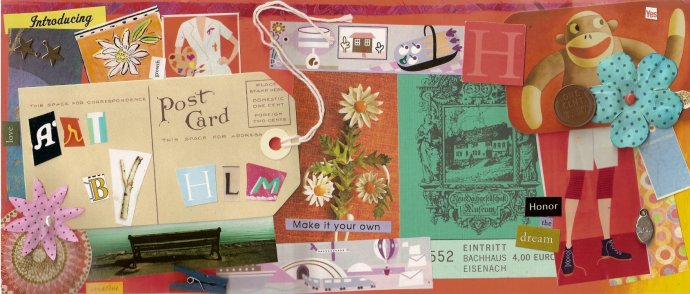
Michelle put this lovely collage of my work together, and you can definitely see my style shine through. You can hear me talk about my work and what it is to be a "real artist" by clicking here.

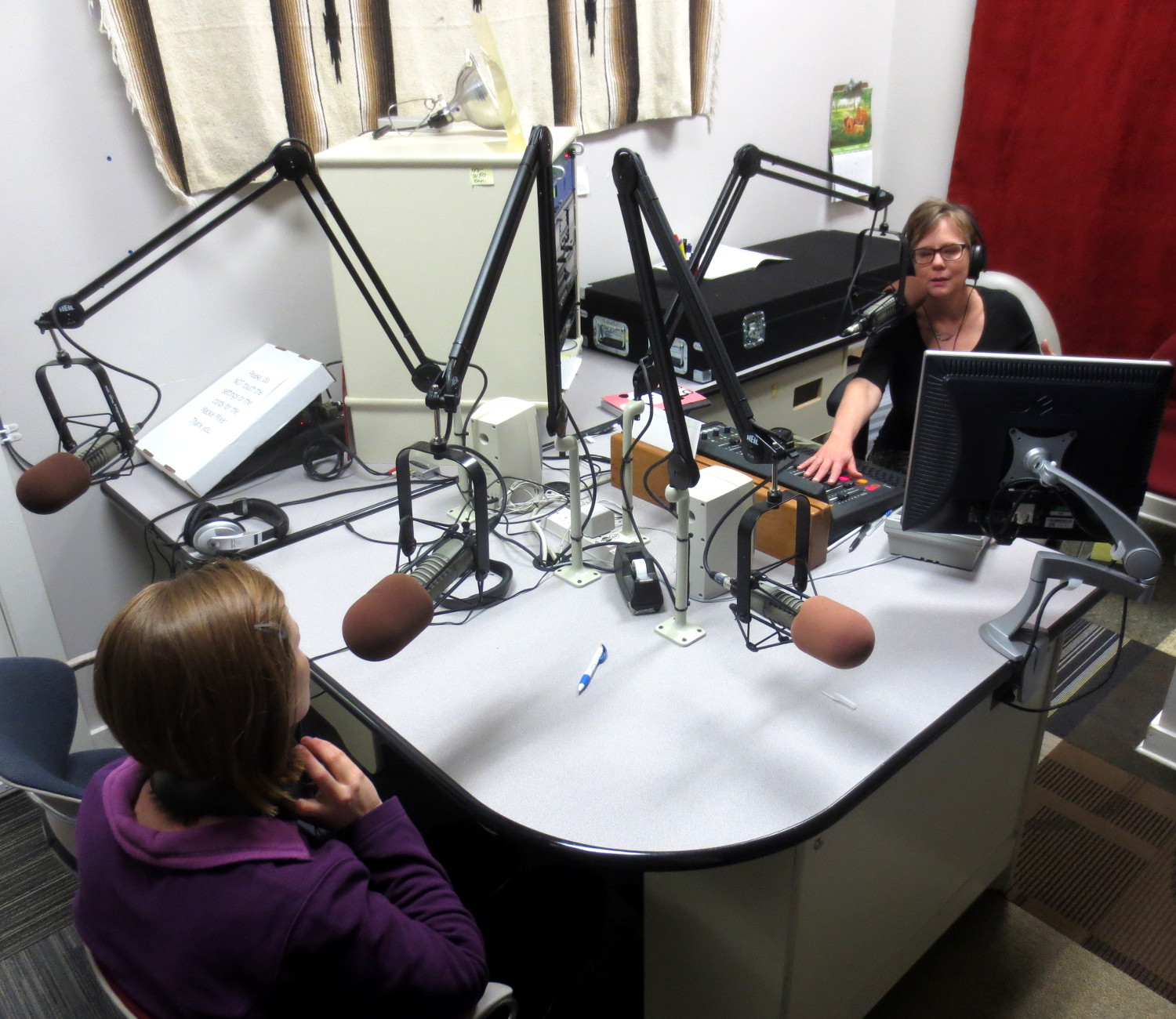
Here are some behind-the-scenes photos of our recording session. It was really cool.The whole thing took about 20 minutes. Michelle asked me a few questions, encouraging me to answer with full sentences since her words wouldn't be heard in the final piece. I loved the huge microphones and the quiet, quiet room. Headphones were optional for me.


Thanks to Michelle Venus and KRFC for the opportunity. It was a lot of fun, and a really helpful part of my journey so far along this "professional artist" path.

Wednesday, December 23, 2015

Bad Times, Good Times

What is it like to be an artist?

As you know, this fall I took a fibers class at the University. Years ago, this is the class that inspired me to start taking studio classes at all, but it had what felt like a hundred prerequisites, so I only just got to take it this semester... finally! In this class, I had about a million + one epiphanies, one of them being that being a professional artist is hard work. My last post was related to this topic as well, but today I have a little more to share about it. 


Antiquis Texere Novus


(Remember that you can click on the photos for a closer-up view.)


Hard work?

Yes, indeed. There is controversy about this concept. Forgive me for any generalizations here, but there are many people, people who are not artists or art appreciators, who think that art-making is "fluff." That art-making is easy. That it doesn't take any special skills, or that a person who calls themselves an artist is just avoiding getting a "real job." Some people think that being an artist isn't a profession of value when compared to a doctor, lawyer, teacher/professor, scientist, factory worker, safety inspector, janitor, pilot, IT specialist, engineer, realtor, museum curator, government representative, etc etc etc. To be an artist means to lounge around, "dabbling" with materials and supplies for fun. As such, it is a constant conversation (I want to avoid the conflict-related word "battle") between serious artists and the world at large, not to mention between the serious artist and herself, about the value of art-making and the outcomes of art-making, and what that value translates to when it comes to getting paid.

This class showed me just how hard it is to make something that is successful at expressing what I feel needs to be said, in a medium in which, despite what I think I know, I am actually a beginner. The benefit (or sometimes the curse) of taking a class is that one is given direction. What is there to be said, for example, in a 24" x 24" square of white cotton? How can it be altered to reflect your point of view? Oh, and please have it completed in ---(too short)--- amount of time.


Walking into the class in August, I had a bit of a chip on my shoulder. I've been sewing for years. I interact with fabric in my work all the time. 

But. Some days I found dyeing to be my nemesis. Setting up a loom to weave for the first time was intimidating--like learning a whole new language. The commitment I had to make to an idea from the beginning didn't always result in the most polished of pieces in the end. Pushing on in the fibers studio--when my back hurt from bending over the loom, or from standing so long on concrete floors, hands wrinkled and sensitive from water exposure and covered in color, or when I was frustrated because I wasn't getting results I'd hoped for, or when it was too cold or too hot thanks to the intermittent HVAC system there and I was missing out on other things that matter to me, like time at home with my family and my couch and my not-so-bright lights--that was part of the hard work.

There was one moment when I doubted myself and ability so strongly, some part of my brain asked, "Who do you think you are?" (This is when I knew I had to call it a night. After a hot meal and a good night's sleep, I was lucky enough to get out of that space.)

BUT THEN!!!! The good times! The benefits! The positive outcomes!

For my final, I had a strong idea, the result of a sample I made serendipitously, without meaning to.


The project is called Reflect. Connect. I actually painted the yarn on the loom so I could have the colors I wanted.


8" x 8" pockets you could slide your hand into and interact with. Texture, light, weight, feel, movement, color. Oh, and what's this little thing? A tag, with a prompt: 

When is the last time someone did something nice for you? How can you help to restore someone's faith in humanity?

When is the last time you had fun? How often do you play?

Reflect.

Oh, here's a button, and on the other side a hole. Oh that person has one too. I wonder if they can connect? What's their prompt? What does that person have to say? Who are they?

Connect. 


The critique was slow at first (how can I invite people to touch them without putting a sign up that says "Please touch"?) but once the pouches came off their stand, the room lit up. Conversation, distraction, chatter, fun, interaction, reflection, connection.

After class, one of my classmates said, "This is a highly successful project. It is absolutely functional, even though it's not wearable." (Many fiber art pieces are wearable and displayed on mannequins.)

I was on high for three days. Similar to the feeling a surgeon might have upon signing someone's hospital discharge papers after a successful complex surgery, I felt like I did something that mattered. I created something that didn't exist before and it affected and touched people in a positive way. I expressed my idea, that community and humanity are important and that art can facilitate them.

Just like in any profession, there are hard parts and there are great parts. Lucky for me, the good happens often enough, helping to build my resilience so that I am able to push through the hard parts. And, I do have fun! Who says it's not ok to have fun in your work? Who says lawyers don't have fun doing the research for their cases? That computer engineers don't love their work, even when something doesn't work? This is part of finding your career fit, that balance of hard work and having fun, and feeling like what you do matters, to you and to someone else.


Sunday, November 29, 2015

Hours and Hours

What is it like to be an artist?

Making what you need (and want) to make takes time. I mean it. Hours and hours and hours. And I can't just calculate the time it takes to make one project, either, since after I practice a little, I can often crank something out super fast. It's not just the making of a piece. It's the hours and hours it takes to develop the project. It's the time it took to learn the techniques that allow me to even get to the project development. It's my education and experience and time and skills all combined to make a single piece that I can show or sell or hang. 

And then I'm asked to put a price on it that is in line with the current market, where things made abroad in assembly-line factories or by machines outprice me every time. Forgive me for voicing my discouragement (frustration? indignation?) on this matter. One realistic aspect of what it is to be an artist is to question: What is the value of my education, my trial and error, my acquired knowledge, my skills, and my time?

This semester, I'm taking a fibers class at the university. For one of our assignments (a "cover cloth") I made this:
  

The piece is far from perfect, but it is the first one, the prototype, were I to make more and try to market them. These skills were used:

  • Hand sewing
  • Machine sewing
  • Dyeing
  • Screen printing
  • Color selection and matching
  • Drawing
  • Transferring a drawing to the screen printing process
  • Quilting knowledge
  • Computing
  • Spacial sensibility
  • Fabric selection based on type and texture
  • Decisiveness
  • Time management

While I was working hard late one night to finish it, I was on the phone with my mom saying that no one would ever notice this detail that I was putting into it. I was questioning whether it mattered that I include the detail at all. She responded that I had to do the detail for me, so that I could call the piece mine and be satisfied with the final outcome for myself. I considered this and carried on, even later into the night. (I did include the detail!)

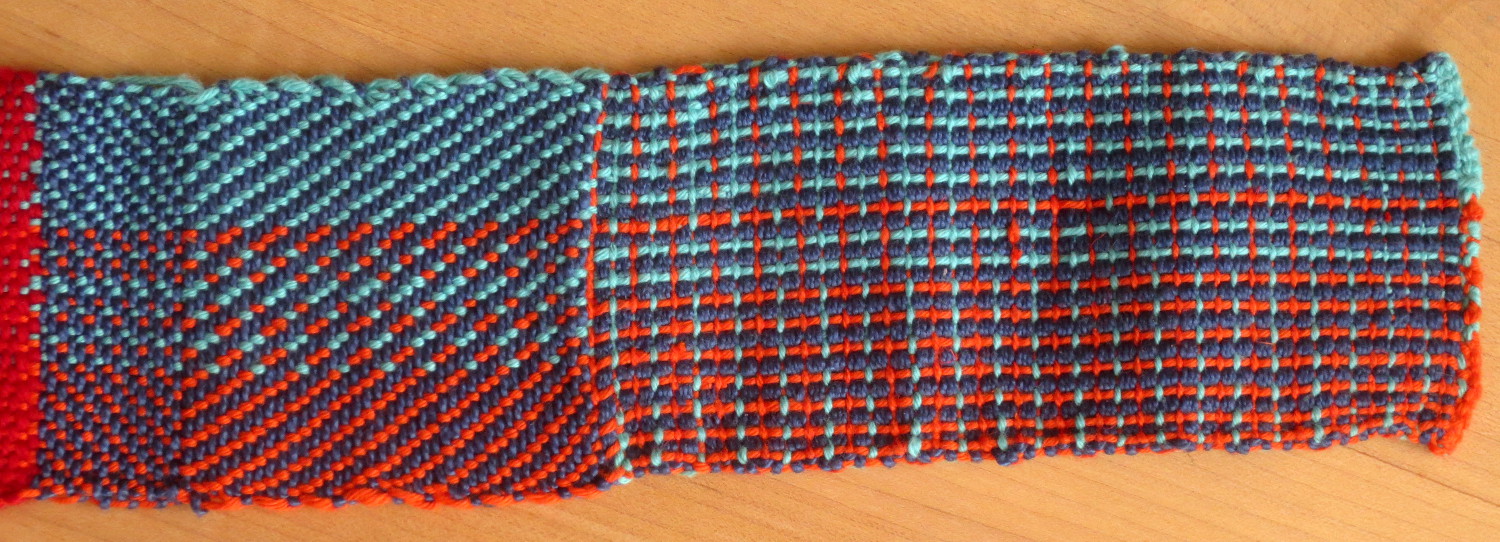
It is the details that make the story of the piece. Have a look at this, my second-ever weaving done on a loom:


Here's a detail:


What are your thoughts, at first glance? What do you notice? What, if anything speaks to you?

Here is the story:

The assignment was to create a progression, one with a beginning and an end. Last month, I celebrated living in the house we live in for six years. It is a special thing for me. I've never lived in one abode for five years, let alone six. 

My progression was to document of all the places I've lived. There are as many inches in the weaving as there are years of my life. Every section represents the places I've lived. Blue is Colorado, gray is Oregon, purple is Germany, etc. If you count up the colors and the different weaving designs within the colors, you'll see 18 different things, which relate to the 18 places I've lived. I had to leave out some places, the ones that lasted less than a year, to keep the momentum of the piece.

Here's the detail of the end, to show my 6 years of living in one house:


What are your thoughts, now that you've heard a little of the story? Has knowing the story and understanding the details made the value go up in your mind? Are you curious to know how long it took, not just to weave this, but to learn how to thread a loom, to learn the new vocabulary (and use it!) and design something for a loom that would come out the way I hoped it would?

A couple years ago I learned about the James Whistler case of 1877. An art purchaser thought Whistler's painting, Nocturne in Black and Gold: The Falling Rocket (1874), was overpriced for what it was, and said so publicly. Whistler took the man to court for libel. The court ruled in favor of Whistler. Here is an excerpt from the courtroom (Holker was the defendant's attorney; excerpt courtesy of Wikipedia):


Holker: "What is the subject of Nocturne in Black and Gold: The Falling Rocket?"
Whistler: "It is a night piece and represents the fireworks at Cremorne Gardens."
Holker: "Not a view of Cremorne?"
Whistler: "If it were A View of Cremorne it would certainly bring about nothing but disappointment on the part of the beholders. It is an artistic arrangement. That is why I call it a nocturne...."
Holker: "Did it take you much time to paint the Nocturne in Black and Gold? How soon did you knock it off?"
Whistler: "Oh, I 'knock one off' possibly in a couple of days – one day to do the work and another to finish it..." [the painting measures 24 3/4 x 18 3/8 inches]
Holker: "The labour of two days is that for which you ask 200 guineas?"
Whistler: "No, I ask it for the knowledge I have gained in the work of a lifetime."

Here's Whistler's piece. And here's to the time and hard work that goes into being a professional artist.


Wednesday, November 18, 2015

Business Day

What is it like to be an artist?

Every morning, the art studio calls. Every night, the studio calls. As much as possible, I answer the call.  Here is what the studio looks like right now--I've got about ten projects going on here. It looks like a complete mess to you, but believe me there is order in the chaos, and it is my sanctuary. As Tom Lundberg says: "Work is worship." I love this.


Yes, any day of the week, I'd rather be in the studio. However, an artist must promote herself. 

Today has been a business day.

  1. Interview potential client for starting a new business (more on that later)
  2. Buy some supplies, including a tapestry needle (what?)
  3. Update my artist bio to better reflect my current artist self (I've changed in the last year and a half)
  4. Photograph new products for selling on Etsy and to FoCo businesses
  5. Email FoCo sellers and attach edited photos
  6. Apply for Support Local Culture
  7. Update blog
  8. Create a new Etsy listing
  9. Post to Facebook
  10. Cook a dish for and attend the Hotdish, the monthly artist networking event, organized by the excellent Elizabeth Morisette, who writes Northern Colorado Art News (you should subscribe)

Business stuff sometimes feels productive, and sometimes it doesn't. It's the right thing to do. More often than you think, you have to do this if you're going to be a professional artist. I'm still getting used to this.

Here is my photography "studio", and the photo that resulted from it. Check out my Etsy to see more.