I have so much to tell you. So much, in fact, that I'm divvying up this post into three posts.
I just returned from a trip to Europe! I started in Vienna, Austria, where I met my mom for five days, who is traveling around the continent for 2½ months, viewing art, music, and literature related sights she's always dreamed of. There we visited the Kunsthistorisches Museum and the Belvedere Palace museum over three days. After we said goodbye, she headed south to Italy, and I flew north, to Amsterdam, Netherlands, where I spent a day at the Rijksmuseum, had a lesson with a local artist, and visited the former home of Rembrandt van Rijn.
In sum, I am a changed person. Humbled, inspired, excited, and so very grateful. Let me show you what I saw.
We spent two full days at the Kunsthistorisches. It was huge, and full of famous things. All we did was look at the paintings. Here were my highlights:
Pieter Breugel the Elder, Hunters in the Snow, 1565
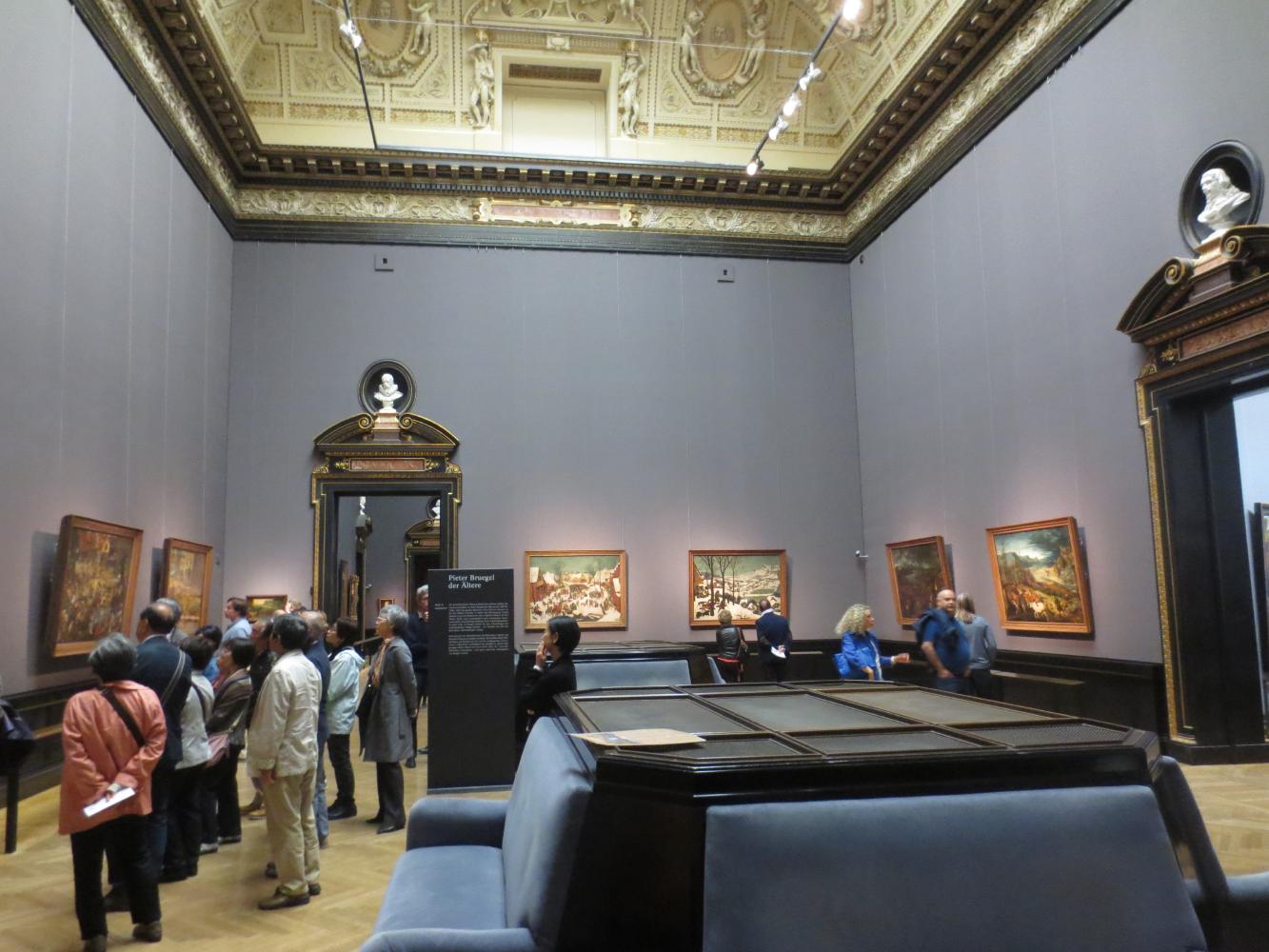
There was a whole room devoted to a significant collection of Breugel's work, and I remember liking this picture when I learned about it in my very first art history class in 2013. Breugel painted a series of "season" paintings, and this one represents winter. Winter landscapes were not a thing at that point. Breugel was the first to paint such a scene. We spent two hours in this one room, as there were so many other great paintings in there. To get a better sense of this room, you can actually see it in a movie called Museum Hours, available to stream on Netflix. This movie was a great introduction to the museum before I saw it for myself. (Of course, it is no substitute for being there in person!)
This is the Breugel room.
This painting (below) caught us off guard in terms of how much it interested us: Ecce Homo, painted by Titian, 1543. It is huge (each person in the painting is at least the size of a real human), and there is so much going on that you don't even notice until you sit in front of it for 15 minutes at least. The audio guide helped us come to love this piece.
We knew Vermeer's The Art of Painting (1665-1668) was somewhere in the museum. We found it tucked away in a dark and quiet corner, almost as the painting itself suggests. I was surprised to hear that Vermeer was not famous for a couple centuries! Now, only 35 pieces of his work are known, and very little is known about the artist himself. This painting is one of the earliest to depict an artist at work in his space.

A real highlight was seeing this beauty in person. I've known this painting for years while knowing nothing about it. There are so many interesting things to say about it! It's called Madonna in the Meadow, painted by Raphael in 1505-1506. Everything in that period of painting had to do with harmony: how the humans were depicted (round and healthy), composition (note the triangle of the three figures repeated in the triangle of the mountains behind them), etc. This is also one of the first times Mary was depicted outside rather than inside or enthroned. My favorite part, which you can hardly see in this picture here, are the gold highlights. Raphael signed the portrait in gold paint to look like embroidery in the edge of her collar.

I believe that I looked at every painting on that floor of the museum, and in total I counted three paintings by women! I was so relieved to see them. Sofonisba Anguissola was one of the first renowned women painters documented in art history. She was born around 1532 and lived a very long life. This small self-portrait was done when she was quite young, in 1554. She is a painter worth knowing about. Here is a link to her Wikipedia page.
Tiny, but really great.
Two other paintings by women were this one, by Dutch painter Rachel Ruysch (1664-1750), and there was a huge painting of Marie Antoinette, by French painter Louise Elisabeth Vigee-Lebrun (1755-1842), and my photo of it is not worth showing!
Mom loved the Caravaggio room.
This was another painting I'd studied in art history, called Archduke Leopold Wilhelm in his Gallery at Brussels, ca. 1651, by David Teniers.
And here is one of the rooms at the Kunsthistorisches Museum.
The museum itself is quite a beaut, built for the very purpose of housing the art within.
Can you believe that was all just one museum? Another day we visited the Belvedere Palace museum, where we spent at least a full hour looking at about ten paintings by Gustav Klimt. My mom is so well-read in the history of the humanities, plus she trained for a year to be an art museum docent, that this hour was possibly the best of the trip. We completed geeked out! We discussed subject, interpretation, style, context, and emotion of each painting. To learn that he finally found his style, the thing that made him famous, only in his 40s, was encouraging and inspiring. It was these later works that have made him a permanent fixture in the story of art history. I've never loved Klimt's work, but after this short but rich visit, I at least understand him better and appreciate his work all the more.
Gustav Klimt, The Kiss, 1907-1908
Gustav Klimt, Fritza Riedler, 1906
Gustav Klimt, Portrait of Amalie Zuckerkandl (unfinished), 1917-18
My time in Amsterdam is elaborated on more in the next two posts, but during my visit to the Rijksmuseum, I got to see some moving pieces. Besides the Rembrandts, which you'll read about below, I saw Vermeer's The Milkmaid (ca. 1657-58), which was quite small. I loved the audio guide's description of why this painting is so special--much of it is to do with the attention to detail and its composition. Right above her upper hand, there is an actual pin hole in the canvas, which served as Vermeer's vanishing point. The details around the figure, such as the shadow under the nail in the wall, and the Delftware tiles that serve as a baseboard along the floor, add visual interest. Another cool thing is that X-ray pictures of this painting have shown that Vermeer originally painted a map on the wall behind the figure, but then painted over it to strengthen the composition.

I visited this museum on a Saturday and it was very busy. Here is Rembrandt's The Night Watch (mentioned again in the post below), and the constant group that surrounded it:
I actually saw a Youtube video of President Obama getting to view this painting in 2014, which I found helped me be more patient with the fact that I didn't get to see it without the throngs of people in front.
To end this post, it seems appropriate to share my favorite piece in the Rijksmuseum. Winter Landscape with Skaters, painted circa 1608 by Dutch painter Hendrick Avercamp.
One of the information sheets near the painting said this: "Avercamp specialized in winter landscapes. This scene on the ice is one of his earliest and most elaborate pictures. The artist chose a high vantage point overlooking a frozen river teeming with figures at play or work. With his panoramic views and anecdotal style, Avercamp was following the Flemish tradition, specifically that of Pieter Bruegel."
And we've come full circle!